Hope and Time July 4, 2020

silhouette-of-person-holding-glass-mason-jar-1274260

Today I was inspired to write this post as an urgent message to my well meaning friends and associates.

Across social media today will be filled with reminders of  how much our world has changed.  Notably, most of them will be messages marinating in fear and helplessness. All will cry for action and point fingers of responsibility, some directed inward, most directed outward.

Today I encourage you to remember our place in Time.  We live in a brief moment, marked only because our species started counting a few thousand years ago.  A skoshi of time which has been repeated before: shifts in climate, plague, empires rising and falling, people at war with one another.  Time as we know it seems to force an unalterable destiny, as if the path is only changable if everyone comes together in one giant consensus.

Our place in Time is not really about whether we wear masks, change political alliances or even love one another.

Our Time is one of self annihilation of our species.  It will not be remembered when the Universe marches on.

So why, then, should we continue to wallow in self pity and bemoan the behavior of  mobs?  I encourage you to resist the temptation to use platitiudes, even those which measure the best humans offer.

Instead I encourage you to reflect on Time, and your time, here, on Earth, and in the Universe.  Find where you connect to Time, and how your time has meaning.  But Time has no room for self pity and woe. Time is active.  It moves across all of us.  It precedes and follows us.  It will leave us behind.

So, if you find your connection to Time in a Higher Being, the planet or your friend, explore it for all its wonders, what it hides, what it reveals.  But, find your actions in it.  Observers do nothing for and with time.  Time requires action!


Lessons in Leadership under COVID-19

If any city, state, country or region doesn’t know where to start when leading their people through these challenging times, you have someone to look to: Governor Charlie Baker of Massachusetts, USA.

Normally, my life revolves around issues and movements at the Federal level, as I am both a Federal employee and a military spouse.  We move frequently, and take a ‘do no harm’ approach to local and regional politics.  Our hands-off approach is in recognition of our short time in the area in which we will live, and the longer term impact which voting locally means.

So, even here, in my home state, I have defaulted to the expectation of Federal regulations governing my life.  In the current circumstances there are crickets and confusion at the Federal level.

Thankfully, Gov. Baker is in charge, and he is taking no prisoners.  Daily, his afternoon tv briefings update the Commonwealth on issues from personal protective equipment (a.k.a. PPE) availability for hospital employees and first responders to supply chain, to education.  He is well versed in the employment issues caused by the state-wide closure of non-essential businesses, and created his own economic program to address it.  He is clear, direct, and informative.  He is not afraid to say that there are more answers needed, nor to criticize the lack of direction and misinformation coming from Washington.  He is not political in his statements, either.  Instead, he focuses on what needs to happen for the 50 Governors to act in the best interest of their constituents.

There are lessons here for all of us: be clear, know what you need to understand, and be ready to change.  People are always looking for leadership in times of crisis.  Be that person.

I encourage you to view any of Gov. Baker’s daily briefings.  Any one of them will make you feel good to know that at least in one place, the steady hand of real leadership is there.  https://www.mass.gov/covid19-updates


Gov. Jerry Brown – An Imperfect Sustainability Leader

There is one man who has made, and continues to make, a profound impact on my life.  I have yet to meet him but living in my newly adopted home state of California, he influences decisions I make at work as an energy manager and at home when I buy gas, turn on the lights or pay my gardener.  I can call him by name: Governor Moonbeam.  Edmund Gerald “Jerry” Brown is the outgoing leader of one of the largest economies on earth (6th, if you don’t account for the high cost of living).  As Governor of California for the fourth time, Jerry has a unique place in contemporary history as both the politician that doesn’t go away, and a man with a clear social mission.  For 40 years, Jerry Brown has not only served California, but his social activism and environmental awareness has been a steadfast reminder of what real American inclusion and idealism is. As a younger politician he was often ridiculed for being idealistic.  Today, this idealism would still be considered forward thinking and inclusive.  As an illustration of the context in which he leads, during the 1980 gubernatorial election, he ran on a platform of “protect the earth, serve the people and explore the universe.”

Brown was born into a political family.  His father had also been California Governor, and Jerry was educated at socially liberal institutions University of California Berkeley, and Yale. Before graduating college, Jerry entered training to become a priest.   This laid the groundwork for considerable social awareness and an understanding of how politics works.  He was a man built for politics, entering adulthood in the 1960’s—a time of liberal thinking and questioning in a liberal part of America.  These experiences formed Jerry Brown’s opinions and beliefs and serve as confirmation to the authentic leader he became.

Why is Jerry Brown a sustainability leader?  We can observe his most recent foray on the international stage at the climate conference in Bonn.  Directly opposing America’s withdrawal from the Paris Accord decided by Donald Trump, Brown lead a delegation of American governors and mayors to Bonn, to demonstrate their dedication to SDGs.  Taking a stand on climate issues is not new to Brown, nor is he ever been afraid to speak out in opposition to another popular politician.  Today, he is a liberal elder statesman who had many battles.  Some he has won, others he lost.  Never afraid to contribute, and willing to move from high political office to one of lower standing at the local level, he also never tires of the fight for social justice or environmentalism.  So, to serve the public has been his life’s work, and he has been a progressive, activist leader.  Like many sustainability leaders, he exhibits a keen mind for financial responsibility, and is a fiscal conservative.

Brown has aligned himself with other progressive leaders such as Cesar Chavez and Bernie Sanders.  He was the first to appoint a gay judge, and appointed women and minorities to posts in the 1970s, when few were represented in political positions.  He remains a vocal supporter to women’s rights and continues to align himself with the plight of migrant workers and ‘Dreamers’ (those brought illegally to America as children and who have no official status in the U.S.).  He has been a vocal opponent to the Trump administration’s anti-immigrant policies, signing a bill into law which makes California a ‘sanctuary state’ for its 2.3 million illegal immigrants.  The law means that police cannot ask people about their immigration status and prohibits law enforcement from participating in any federal immigration actions.  He worked to create accountability in politics in the 1970’s and opposed the death penalty.  The combination of fiscal conservative and progressive social leader means that Jerry Brown must be savvy and collaborative in how he executes his large scale environmental vision as well.  He suffered a defeat when he wanted to re-route water from Sacramento to Southern California in 1982 but persisted and succeeded in 2013 with his environmental vision for California, which called for a power grid with 50% of its energy deriving from renewables.  This is especially important for southern California, which gets most of its energy from the hydroelectric power produced in the pacific north west.  Distributed renewables reduce the amount of transmission line losses in place over the long distances currently traveled, because renewables can be placed in the desert of southern California close to large consumption hubs like Los Angeles and San Diego.

Jerry Brown is a template for many Americans who want to feel enabled to action.  He envisions a world of social and political equality, equitable distribution of wealth and a clean environment.  He acts in accordance with those beliefs, and uses his popularity, notoriety and position to achieve sweeping reforms and enacting aggressive and progressive environmental programs.  However, he is often unfairly criticized for not doing enough in the cause of climate change.  California’s export of fossil fuels, and the economic impact they have on the state’s economy, has not escaped his critics outside the U.S. Brown, however, understands the context in which he operates, and can effect change.  Oil drilling in California accounts for many unskilled and semi-skilled laborers, and much downstream tax revenue.  Ceasing drilling operations completely and suddenly would leave a large gap in revenue and employment for Californians that no other industry can quickly ease.  Therefore, it is important that any transition happen with care paid to the people and companies most effected.  So, to be Jerry Brown is to have a thick skin, a determined nature, an inquiring mind and endurance.

I am as energized today as I was when I worked on his presidential campaign in the early 1990’s.  I see myself at the podium, shouting down with righteousness in support of social justice and environmental protection.  I can be secure in the fact that win or loose the battle, like Brown I will keep trying to make the world sustainable for future generations and should not let one defeat end a noble task.


New Leadership Challenges: Forgetting Progress Comes Too Easily for Some

A couple weeks ago, I participated in a working group tasked with shaping the message we would deliver to the four star general on the state of our energy programs.  The level of confusion was astounding.  One always expects some amount of conflict whenever a diverse group meets.  This was a new layer of chaos to me.

But, first:

As I have been settling in to my role in Energy Management, I have been confronted with several harsh realities.  First, my boss is a very vocal climate change denier.  He justifies his role in reducing our energy consumption as a matter of cost savings, not green house gas emissions reductions.  This is in direct conflict with our Agency agenda, and creates tension with our work colleagues in the Environmental Compliance section.  His denial makes a bigger impact than just the social conflict: our section also chooses the technology to use in major construction efforts on the installation, as well as improvements to the resiliency of the energy supply (both from the electric grid and the natural gas network).

As a consequence, our most recent resiliency efforts have been focused on the use of natural gas micro-turbines.  While natural gas burns cleaner than the diesel  it replaces, they are not environmentally friendly.  In order to be an effective, reliable source of heating/cooling and electric generation, they will be run 24/7, emitting CO, CO2 and NOx.  That’s right: producing GHG 24/7.

I continue to search for substitute technologies to no avail.  At the city-scale, this is what we create microgrids with, and I’d better get used to it.

My boss was happy to hear of the repeal of the previous executive orders mandating adoption of cleaner technologies and reduction of carbon emissions.  Even with their repeal, however, that doesn’t mean the agency changes its policies on climate change.  This is what I was banking on when I went to the working group.  Cooler heads, with a long vision and a “stay the course” attitude.  That isn’t what happened.

In fact, the other members, except those in uniform, where happy to no longer have any restrictions to the emissions they created or the products they used.  They were even giddy.  I suppose they forgot that California has climate friendly policies, too.  Of course, I reminded them.  It didn’t help.  You see, that the new administration has emboldened ignorance, and slighted truth.  If it isn’t easy, and in one’s self-interest then many people aren’t interested.

So, mine has become a campaign to undermine the ignorance.  I won’t waste my breath on the entrenched.  Instead, I look to remove components which make our footprint worse.  When asked by senior leaders, I find the compelling reason to say no to certain technologies.  I will seek out the GAO officials who came to our installation for a site evaluation, and I will answer their question:

No, we are not doing anything about climate change.  In fact, we stand to create more GHG than a year ago because of this new technology.  Yup, I am going to drop a dime on us.

And while we all wait for the GAO report to come out, I will continue to seek out new, clean technologies and expert partners to keep my corner of the world on track.  Solar, wind, biofuel– whatever it takes!

This is my ongoing leadership challenge.

Gallery

California’s Energy Consumption and the Law of Unintended Consequences

All things California aren’t as sunny as marketing firms would have you believe. While it is important that Gov. Jerry Brown and his predecessor, Arnold Schwarzenegger, have been active in making California a leader on the climate change stage, CA has been making some interesting, and potentially dangerous choices.

California’s energy initiatives are the pornography of the sustainability world.  Renewables accounted for 29% of electrical generation in 2016, and sources range from landfill gas/biomass, geothermal, hydroelectric facilities and, of course, wind and solar (photovoltaics and thermal).

Where are the choices for Californians? 

There are the routine measures they take daily (shut the lights off, reduce the heat or moderate their A/C temperature).

Then there is a big leap in span of control: the affluent can choose solar panels for their homes (at their own jeopardy).  While state-funded incentives exist to encourage roof top solar panels for homes, in reality, solar energy installation and secondary generation businesses (Solar City) capture the incentives while consumers end up paying both the company and the public utility.  During times of excess generation, a solar credit is given to the home owner at a much lower rate than they would pay if they were actually buying from the grid.  No battery backups exist for homeowners, leaving them at the mercy of two predators.  This is the situation individuals find themselves in for the 20-year payback of the solar panels.  So much for sustainable, good choices for consumers.

They choose their law makers and government officials who advocate and choose the energy mix consumed.  However, the real choices are being managed, like a puppet on strings, at the Calif. Energy Commission.  While there are a multitude of renewable energy programs incentivized with taxpayer money, this does not tell the whole story.  Frequently, these incentive programs are awarded to the utilities, Federal government campuses, and third party “green” programs whose consultants are often from another state.

The Hypocrisy of California Sunshine

CA is the 3rd largest producer of oil behind Texas and North Dakota (https://www.eia.gov/state/?sid=CA)   and is responsible for producing over 1100 Trillion BTUs of energy from crude oil alone.  While it is not the sole consumer of this energy, it is effectively responsible for the GHG’s produced from the oil.

Within California, 44% of electric generation from natural gas.  Clearly, CA hasn’t shed its reliance on fossil fuels.  And let’s not forget its nuclear power plant at Diablo Canyon.
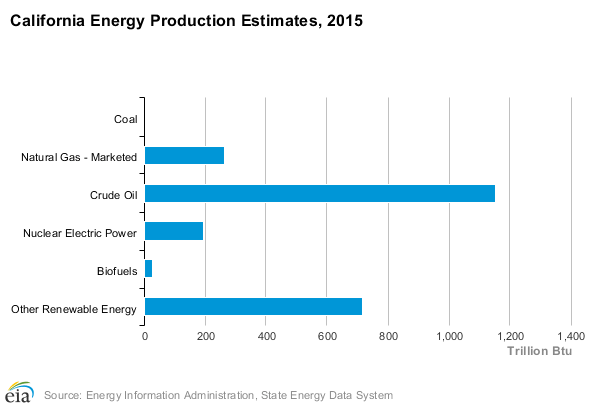
CA grid sources of energy

Unintended Consequences

California’s goal of obtaining 50% of energy from renewables by 2030 was signed into law in 2015.  Yet, only 5.5% of it’s grid available energy is from solar, despite its claim,


“California leads the nation in solar thermal electricity capacity and generation. In 2016, California had 73% of the nation’s capacity and produced 71% of the nation’s utility-scale electricity generation from solar thermal resources.” (U.S. Energy Information Administration, California Profile Overview Facts, eia.gov, Nov 2017).


California is also the largest consumer of energy in the U.S., but ranks 49th in the nation on a per capita basis.  This means California industries are consuming abundant amounts, while taking the incentives funded by taxpayer dollars, who are reducing their consumption.

Then, real problems exist for energy storage.  Like the homes here, the idea of large battery banks across the state may not be feasible.  Load displacement on a state scale would need to be buttressed by a regional grid agreement, which does not yet exist, although there are government advocates for it, including Governor Gerry Brown.  This means that the energy generated from renewables must be consumed or distributed in real-time.

Except….

No plan exists for energy storage.

Additionally, State Bill 100 upgraded targets to 60% of energy from renewables by 2030 and then requires the final 40% to come from “zero-carbon” sources that don’t produce greenhouse gases by 2045.  They expect the gap to be filled with large hydroelectric plants (which are currently not considered a renewable source under CA law).  This also means the elimination of natural gas-powered generation plants, which currently fill the generation gap during peak consumption times.  Oh, yeah, and they are closing their last nuclear power plant.

So, the California equation, as it is currently planned is:

0 natural gas generation  +  0  storage capacity (battery or otherwise) = 0 ability to store and manage its power grid effectively during peak consumption times, times with no sun, and times of emergency.

What’s more, without a codified agreement within the western states, CA won’t be able to have planned, reliable redundancies.  It is true that the state buys some hydroelectric power from the pacific north west, it is not capable of delivery that power to southern CA.  That means large population centers like Las Angeles and San Diego will be isolated during a grid emergency.

Picture millions of people, in the hot desert conditions of SoCal without electricity, and without water (because pumping and sewage stations need power to work).  Today, 28 million people live here.  The modest drop in population projected won’t relieve the pressing need for a systemic energy plan for the region, and the state.  https://la.curbed.com/2015/1/22/10000130/predicting-who-will-be-living-in-los-angeles-in-2030

So while we extol California for its hard work on behalf of the planet, the unintended consequences of is love of wind and solar is a neglect for the resilience of the same power grid.

Leading from the Middle: Yet ANOTHER Personal Leadership Blog

Shall I speak of energy management?  Perhaps the tenuous state of institutionalized environmentalism?  Social justice?  Mr. “T”? Ah, the opportunities are endless…

I was told to blog, yet again, on my “journey.”  Anyone who knows me would know that I am, at this very moment, writhing in my seat at the word, eliciting a visceral reaction akin to hearing nails on a chalkboard.  Journey?  Reflection?  Should I have herbal tea while I write this?

What happened to, “how’s it going?  what are you doing these days? How is XXX working out for you?”

“Let me tell you…”

My colleague is much the same: still convinced she has energy management “covered” by reporting utility usage.  Secure in her ignorance, and despite multiple explanations about the fact that reporting utility usage to headquarters involves reporting ALL of the energy used– not just the amount we bill our customers for– she remains entrenched.  I have reached out to her to teach her what to monitor, what systems need updating and how to measure lighting output.  Nada. Zip. Zilch.

I give up.

I am not giving up solely because she is foolish.  My hands are in the air and my head is shaking because middle management does not know or care about energy management, never mind energy conservation.

That’s right: even in government, leadership buy-in is key to success.

So, since apparently, the higher your pay grade the less you need to listen, I am on the wrong end of this informational transaction at my current position.

Thankfully, I have been offered a position where energy management does matter, and innovation is the way they do business.  And, yes, it is still with government.

“Ok,” you think, “why does energy management matter in some places, and not others?  You will be working for the same government you work for now.”

That is a good question.

The answer is still ‘leadership buy-in.”  My new position will expect me to investigate innovative solutions, to understand the underlying engineering and to continue the good work already established through Public Private Partnerships (PPP).

This is great news for me.  Not only will my skills as an engineer be used daily, but my passion for doing creative things, and working in service to others will be part and parcel of it as well.  Could you ask for anything more? Oh yes, I did get a promotion, too.

Maybe “saving the whales” or “hugging a tree” are a little over the top for my taste.  Those elephants are big, and take many, many bites to eat.  For me, these new challenges are more practical, and within my comfort zone.

That’s right- I said it- COMFORT ZONE.  (did you like the energy themed play on words? )

Often, the business guru’s of the world talk about stepping outside your comfort zone to grow (I am pointing at you, your silly organizational behaviorists).  I have news for them: that works on a personal level, not when you are trying to create institutional change.  You want to KNOW how the organization works, and how people think, before you try institutionalizing change.  Especially when you are leading from the middle.

Why?  (stand back, I am going to throw a little Sun Tzu at you)

Because you need to know the enemy: whether it is ignorance, entrenchment, limited money, or no pay-back.  What ever it is that currently makes your organization tick, you need to be all over it, like white on rice (or brown on rice, for those with a penchant for it).

There are only two things that will really make a difference when it comes down to it: knowing my strengths, and knowing how my organization works,  so that I can create change from within my organization.

So, I will rock the energy management world in the way I know best: hard work, understanding how details illuminate possibilities, lots of engineering madness, and changing my organization from within.

Ta!

Now PLEASE: NO MORE “JOURNEYS”….

Response to Implications to a ‘just transition to a low-carbon economy’

The working paper to which this article refers is entitled, “The multiple meanings of justice in the context of the transition to a low carbon economy.”

The students were asked to choose a question based on the area in which they work.

The question I chose to answer which is best suited to the context of this specific report is the question, “How does the concept of a just transition relate to your sector or organisation?”

I work for the U.S. Federal Government.  So, it always interests me to see where those who work outside government believe there is a need for explicit government intervention, or perhaps just how they view the way government works.  This document doesn’t go into that level of detail, so I will comment to the general concepts and framework presented.

The document is a survey of background information, where it meanders through various understandings of justice.  So, it has a particular use as a survey of the topic.  The authors define a framework (which they assert is common to a multitude of viewpoints).  The elements of equitable distribution, recognition, equal participation, and equal capabilities find definition in the paper.  However, I dispute the universality of their meaning, even from a western viewpoint.  Specifically, within the context of the United States, these terms take on political meaning, and do not have an agreed upon definition within the American experience.

In fact, these terms are used both internally and externally, and the concepts reach to the core definitions of how we Americans view what our basic freedoms are, and how we view the rights of man around the globe.

Without making claims to a particular interpretation of these views, I can say that the discussion of justice itself is held often and publically.  It bridges themes from housing, to food, urbanization, education and environment. It uses empowerment and access on the left, and opportunity and choice on the right, as a path to justice.

The direct connection between the state of the physical environment and (social) justice is the particular part which is still in its infancy in U.S. Policy and government oversight.  The concepts of justice in all other aspects have been fundamental questions since before the birth of our nation, and so there is no new ground here: we are very introspective in that regard.  So, these questions and aspects of justice would be natural questions on a transition to anything for the U.S.

However, when environmentalism and justice are linked, the connection has its limitations.  It is these specific limitations that must be addressed in order to transcend the ‘problem’ mindset, and move to a ‘solutions’ mindset.  Next, it must also be realized that regulation is not the sole answer to this transcendence.

The Link:  The link (as it is currently perceived) is not a complex one: Pollution is bad, so let’s eliminate pollution.  Instead, the problem should be framed in its more complete form: pollution exists because we choose to live a life which values certain activities over others, at the expense of the well-being of our fellow Americans, their children and our world-wide neighbors. Then the link becomes richer: our values create a world in which we endanger the lives of others by polluting and pillaging the natural environment around us.  Here, we have a statement and a way of thinking that links WHO we are at our core (i.e. values) to our negative impact on others (polluting and pillaging).  If we want this transformation to occur, we must make the message one that is more complex, personal and direct, and avoid long discussions over the history of the concept of ‘justice.’

The best and highest way the U.S. Government can meet this challenge is when it is so embedded in our collective morality that we don’t need regulation and oversight.  That, of course, is an ideal.  Realistically, education gets us to understanding and accepting the real complexities of the link.  The effort to educate Americans needs to start now, and include children and adults.  It should be a marketing campaign.  It should be everywhere.

Practically and historically speaking, we already regulate business, personal and government operations to address social justice issues.  Linking them to a low-carbon economy transition would most likely take the form of incentives and prohibitions.  This is de rigueur for western governments.  But how do you create the longevity needed to create a robust transition?  After all, this could take more than a four-year election cycle to create, and 100 days to stall (sound at all familiar?).

The most practical answer is embedded in the education of adults, and creating a sense of urgency with them.  Strategic, forward-thinking, planning and enabled middle managers are key.  This does not need to be driven from the top.  It can seep in from the middle.  Some of the most effective transitions in government have happened this way because the base of the pyramid (and middle) already understood the need for the just transition.  For example, the acceptance of the LGBT community in the military was not driven from the top.  It came about because the American people, and the soldiers and sailors of the armed forces, saw the social and employment injustice arising from the ban on LGBT’s serving in the military.  These alternate lifestyles were already openly accepted in America, and in the homes of military members.  When the Pentagon did a study on the issue, it found acceptance and support of LGBT issues already existed, driven by the youngest members of the services.  In a like manner, the governance of a transition to a low-carbon economy can best be achieved.

Regarding the paper itself:  There was awkwardness in some of some of the language: cyclone Katrina v. Hurricane Katrina; ‘functioning environment’ needs clearer definition, and claiming that some arguments were ‘nuanced’ seemed inappropriate for the discussion.

Transition to low carbon– how feasible is it?

What a great idea– let’s all transition to a low carbon economy.  It is a noble goal, and what some expert believes is the only real solution to a more sustainable world.

I must say that I think the goal is enormous, and particularly difficult (if not unrealistic) to assume that the US Defense Department will be able to become ‘carbon free’ any time soon.  The noble effort has been underway for many years, extending as far back as the G.H-W. Bush administration.  The beauty of these long term and slow rolling efforts is that small changes made by DoD can result in large positive results. For example, typical DoD energy programs actively work to replace legacy systems with more energy efficient ones.  Lighting projects (or light-replacement projects) are the low hanging fruit of our sustainability programs.  Need a new vehicle?  Consider an electric or LPG vehicle.  The list goes on…


The real challenge for DoD’s efforts is nothing less than Presidential.  That’s right.  When, after last November’s election,  the then Commander-in-Chief-elect called for a list of anyone who attended climate change conferences, a shudder ran down our collective backs.  Similar to a Red Scare tactic, the intimidation factor was clear: we would be in his cross hairs over the coming four years.


In spite of two  Executive Orders, a National Strategic Plan and many lesser directives, DJT wants to throw the clock back, recinding decades worth of instutionalized progress which not only contributes to reducing the government’s environmental impact, but also make good practical sense.  Energy use reduction goals also reduce our reliance on foreign oil – that’s good national defense.  Water use reduction is also in our national interest as it becomes a more precious commodity.


We have also begun to look at how we help others live more sustainably.  Our huanitarian assistance programs are another key to reducing our footprint and those whom we assist, as we work towards using updated technology and systems to creating lasting outcomes.  This tranistion will continue, as both civilians and military are inspired by the prospects of making humanitarian assistance even better.  State of the art technology and thinking are tools for us to reach these goals.


So, when DoD aims for a low carbon economy, what it is doing is looking long term, and to effect as many people as possible, both within the ranks and outside the organization.  Four years is nothing to be worried about.


African Nations Leave ICC–now what?

Breaking News:

Got this on the news read this a.m. and wanted to spread the information.  I am not sure what this will really mean for human rights, especially on the African continent, so I look forward to learning more from my South African friends.

BBC has an article, as do the other major news outlets.

http://www.bbc.co.uk/news/world-africa-37771592

WWF Communicates Successfully

When I see the panda, I think of World Wildlife Fund.  This is exactly what the marketing folks with WWF want me to do.

I have no heartburn with branding, especially when the cause aligns with my values.  How did this happen?  The historical foundation of WWF is one of philosophical conservancy, supported by scientific findings and backed by large private donations.  It has evolved from a single manifesto in 1961– The Morges Manifesto — which declared the need to actively fund conservation efforts.  Today, it addresses the range of climate change areas, and declares,

We work globally, with every sector, at every level

(see http://www.worldwildlife.org/initiatives)

The beauty of the WWF message extends beyond the distinct message of conservation through the protection of endangered species.  The beauty is in the cultural legitimacy it extends to these controversial subjects.  WWF was founded by rich and influential people who understood the need to address the way humanity takes care of the earth.  These ideas were publicly discussed in the 1940’s by precursor organizations.  It continues because its education programs reach children as well and have become a part of our collective consciousness.  Today, education materials from WWF can be found in classrooms and donation slips in the mailbox.  “Live Green” is one such effort.

It could have easily regressed into a caricature of  environmental responsibility– fuzzy panda, pretty tigers — or simply remained a one topic organization.  As it matured scientifically, it ran the risk of becoming involved in too many things, loosing focus on its key principals.  Instead, it acquired depth of proficiency.  Over time, that proficiency expanded through leveraged partnerships in marketing, humanitarianism and corporate partnerships.

In a world where partnerships often equate to compromises, remarkably, WWF has maintained its legitimacy as a leading conservation organization while partnering with controversial corporations like Coca Cola.   Coke has been criticized on a variety of sustainability issues including packaging, water rights, and equality.  WWF’s partnership with Coke is centered on the protection of water resources.  The campaign lets WWF influence Coke’s business practices in a positive way, and legitimizes Coke’s efforts to make a positive impact.

This influence/legitimacy handshake is not always successful for organizations.  WWF’s history as an independent advocacy group has help maintain its legitimacy beyond any one cooperation effort.  Charity Navigator  lists it as a highly transparent organization as well, receiving a score of 96%.  Additionally, 85% of donations directly support its programs.  This is a very successful metric for an international charitable organization, and scores slightly higher than the American Red Cross.

WWF also reaches out to influence policy through lobbying and government programs. Marine turtle agreements is an example of policy impact.

Influential people, such as The Duke of Edinburgh, have been leaders of WWF.  He, in particular, was influential in having world religious leaders attend a meeting in Assisi whereby declarations were made that,” conservation was a fundamental element in their respective faiths.” Communicating a spiritual link has helped WWF make conservation a personal struggle that donors should address.

Each of these are extensions of communication efforts which help preserve the reputation of WWF and help it remain successful.


Personal Leadership Challenge as Energy Manager

My current job is as a Community Planner for the government, although my education is in physics and engineering.   Like many middle career professionals, I have a toolkit of proficiencies, talents and expertise.  I also have many interests, responsibilities and aspirations.  These adjectives create more than one nexus.  Most recently, that has occurred for me through an opportunity at work in energy management.

Energy management may seem to fall directly into the silo of engineering.  It is true that to be a successful energy manager for the government, you need to have training as an engineer or have untapped talent as a technician that you have miraculously discovered which demonstrates a clear ability to understand engineering problems and develop solutions independently.  Then, you need very particular training in HVAC and electrical systems, so that you can accomplish energy savings systems alterations with meaningful, quantifiable results.

Seeing an opportunity for enrichment and to make a positive impact at work, I asked for, and received, the technical and management training to run the energy management program at the installation.

Training and permission were not the challenges, but the groundwork to address the challenges.  Or so I thought.   There were an unexpected challenges that were interpersonal, communal, and organizational to address.

The current energy manager, Tracy, is not really an energy manager.  Nor is she an engineer, have technical ability or the desire to have such.  Tracy’s motivation in taking over the duties of Energy Manager (before I arrived) stemmed from a desire to capture more job titles and responsibilities in order to request a pay increase.  It is also, in her mind, a way of securing her position in the workforce when the US Government closes our installation. With additional duties, she thinks, it will position her to move over to another US base, and displace another employee with fewer responsibilities.  We have had many conversations on this topic, so I am certain of these motivations.

While it is understandable that someone would want to secure their position and future employment, it is irresponsible for this particular situation to remain intact.  Since the 1973 Energy Crisis in the U.S. the consumption and pollution caused by the burning of fossil fuels has been a focus of the U.S. government.  On April 18, 1977, President Jimmy Carter gave a speech (text of speech captured on PBS.org) outlining 10 principles to guide the future of U.S. energy policy. This policy position begot a series of executive orders, the establishment of the Dept. of Energy and the infusion of best practices within government agencies to reduce the amount of energy consumed by the Federal Government.

I remember the energy crisis of the 1970’s, and have lived most of my life in an America where reducing energy consumption has become the norm.  We insulate our homes to reduce energy consumption (and reduce our fuel bill).  We consider how many miles per gallon we can achieve with our cars.  We turn off the lights when we leave a room, or use natural lighting as much as possible.  It has, essentially, permeated all aspects of our lives, and triggers automatic responses which are considered good habits. The habit is not predicated on who is responsible for paying the fuel bill.

This is in opposition to the culture I have encountered here in the U.K. at work.  The guilt resides with both U.K. nationals who work for us, and some of the U.S. leaders who have chosen not to make energy savings a priority.

I cannot explain any personal discomfort over the push and pull that some decision makers at my workplace face with regard to allowing operations to contradict habits that are well ingrained in our culture.  I know that I have heartburn after every advocacy I make in support of a robust energy management program on the installation.  It is a matter of conscience for us to continue a pattern of energy savings and to look for new opportunities to create savings.

     Why has this changed if I am in the U.K., and what can I do about it?

It became clear to me that in order to run an energy program I needed a few things:

  1. Agreement and support from leadership that energy savings directly impacts the success of our missions.
  2. Responsibility for collecting and reporting data to higher headquarters on a schedule.  This creates accountability throughout the chain of command for timely response and accurate information.
  3. Access to tools to monitor consumption.
  4. Ability to communicate energy program goals to the entire installation.

These are obvious tools, but not currently in place.  The precursor to all of this requires a much more subtle  approach, and is difficult because it impacts a person’s career and perceived value to the organization.  That is, the current Energy Manager must understand and accept that she is no longer the Energy Manager.  Communicating change within an organization is very difficult when it is perceived as a punishment or a failure.  In this case, the person did not fail– our leadership failed when it assigned technical duties to someone who is not capable of carrying them out.  The organization continues to fail because she is not capable of any energy management tasks beyond billing customers for their energy use.  Compounding the problem, she manages the requests for construction projects for our organization.  Because she does not understand the mandates from government, and the opportunities available through system replacement or upgrade, long term energy savings projects do not get funded.

I took these concerns to my supervisor, who in turn, went to his boss.  Our mutual boss decided to replace her with me in order to reach our energy goals effectively.

While this puts a competent person in place to manage the program, it also missed some crucial landmarks along the way.  No one told her that she was no longer managing the program.  While the deputy reported to headquarters that I was in place, he never told her that she was relieved of the requirements, and told me, “no one cares about it (energy) anyway.”

Moving forward, I have three communication issues to deal with.

  1. I must engage and not alienate my coworker, so we can be productive.
  2. I must convince the deputy that the government is still watching and does care.
  3.  I must establish a program that reminds our installation that we have a mandate to conserve energy.

These are actions that I am capable of accomplishing.  These changes will require much effort — and the engineering has not even begun.