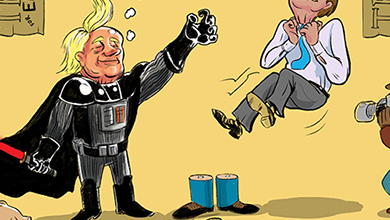
It is Sunday afternoon, and I am doing what I like to do: listening to public radio. Specifically, a piece by BBC 4’s Roger Harrabin. This is one more in a deluge of commentaries on the future U.S. President’s positions on climate change, environmental policy and international agreements. Mr. Harrabin’s episode postulates how the engagement, or lack thereof, by the new administration could effect the global efforts on reducing carbon emissions. Recall that three of his key appointments — Secretaries of State, Environment and Energy — may be filled by climate change deniers, if he gets his way. In the mean time, Mr. Harrabin explains, the Chinese government is quietly, and humbly, positioning itself to be the global leader in clean power technologies.
Say it isn’t so, Joe.
Ahh, but it is. And good for them. Clearly, if this is really the case, and if history proves this to be true, then my wish to my young Chinese MBA colleagues will have come true: learn from the mistakes of America. To refresh memories, we could look back to the acid rain epidemic in the 1970’s. The manufacturing plants of the U.S. Midwest produced emissions containing sulfur dioxide (SO2) and nitrogen oxides (NOX). These compounds when carried along air currents, precipitate out as small particulates (when dry), or combine with the moisture in the air to produce the liquid form most commonly understood as ‘acid rain.’ It took three presidencies to receive recognition, and a fourth to honor our international agreement with Canada regarding pollution (FYI- it was under Ronald Reagan, another climate change skeptic). In 1980, the U.S. Congress commissioned an 18-year study on the topic under the Acid Deposition Act. It took another 11 years before a report was issued, and it still doubted the source of the acid rain. To put this in personal terms, Fish no longer reproduce at a pH lower than 4. It contributes to your car rusting, and your child’s breathing problems. In short, it took a very long time for very smart people with a scientific mindset to convince the Executive Branch of Government that acid rain exists, it is an environmental hazard AND we should take positive steps to mitigate, and possibly reverse, its effects. This is what I hope China has learned from us. So, don’t wait China: the health of your people cannot afford it, and we will all benefit from leadership in these areas.
In the mean time, Mr. Harrabin asserts, the world is holding its breath on how the U.S. position might change away from its most recent progress at COP 21. This is a bit dramatic. Yes, yes, every non-American I know has been wringing their hands, and asking in a whisper: “what do you think will happen?” His interview with Barry Worthington from the U.S. Energy Association attempted to quell fears and give an American perspective on this question. Market and social forces, he says, are in place to keep the momentum moving in a positive direction without the need for more regulations. Hans Joachim Schellnhuber of the Potsdam Institute for Climate Impact Research reiterated the role of market forces in positive climate change behaviors. While my observations of America is in alignment with these two gentlemen, the thrust of the piece still seemed pessimistic.
I agree, to some extent, with the comments make by Jennifer Morgan of Green Peace. I think we can expect a ‘deliberate attack’ from the administration, as Mr. Trump has indicated that he doesn’t believe climate change exists. He might not participate further in climate change talks, or he might try to rescind current policy, or even ignore international agreements.
This uncertainty in policy and its effects are the ‘wobble’ to which Mr. Harrabin refers.
But even if the attack is a lack of action, or an attempt to rescind current legislation is successful, the effects are too little and too late to have significant negative impact on the U.S. climate change recognition. Well developed, integrated, grass-roots policy implementation has already established itself within American Government organizations, their contractors and partners, and in the psyche of the consumers, taxpayers and corporations. He will not be able to undo all of the progressive policies set out since 1993 which address green house gas goals throughout the government in purchasing, building, training and so on.
Take that, Mr. Trump.
The discussion has become destabilizing for many environmentalists. It has become a leadership challenge for me to quell these fears. Because climate change and sustainability professionals outside of the U.S. Government fail to see that what takes much to build in America also takes much to break. In a phrase:
I refuse to ‘wobble.’
So, no matter how many folks around me are in a panic about how the President-elect can change U.S. policy on climate change, I believe that climate change awareness is here to stay. Our Congress is answerable to the citizens. Our citizens want the opportunity to improve our climate’s future for the next generation, and claim economic and social benefit from the green revolution. Our civil servants have detailed, established policies and procedures throughout government operations which have goals and mandates attached to them. Our corporations will continue to innovate in response to market forces, and leverage technological expertise to create financial benefit. We as a country, and as a culture, are on board the sustainability train, even if it left the station without a few key passengers.
Many of us understand that the rest of the world wants more than our buy-in, it wants our leadership. World, I urge you: look behind the curtain and find those of us who do this work in America. Keep asking the questions, but don’t worry too much about the ‘wobble.’
Climate Change: The Trump Card can be found on BBC Radio 4’s website as a podcast http://www.bbc.co.uk/programmes/b086s95f#play
For more information, try the Environmental Protection Agency’s website at: https://www.epa.gov/acidrain/what-acid-rain
Cartoon courtesy of
 More Sustainable World