All things California aren’t as sunny as marketing firms would have you believe. While it is important that Gov. Jerry Brown and his predecessor, Arnold Schwarzenegger, have been active in making California a leader on the climate change stage, CA has been making some interesting, and potentially dangerous choices.
California’s energy initiatives are the pornography of the sustainability world. Renewables accounted for 29% of electrical generation in 2016, and sources range from landfill gas/biomass, geothermal, hydroelectric facilities and, of course, wind and solar (photovoltaics and thermal).
Where are the choices for Californians?
There are the routine measures they take daily (shut the lights off, reduce the heat or moderate their A/C temperature).
Then there is a big leap in span of control: the affluent can choose solar panels for their homes (at their own jeopardy). While state-funded incentives exist to encourage roof top solar panels for homes, in reality, solar energy installation and secondary generation businesses (Solar City) capture the incentives while consumers end up paying both the company and the public utility. During times of excess generation, a solar credit is given to the home owner at a much lower rate than they would pay if they were actually buying from the grid. No battery backups exist for homeowners, leaving them at the mercy of two predators. This is the situation individuals find themselves in for the 20-year payback of the solar panels. So much for sustainable, good choices for consumers.
They choose their law makers and government officials who advocate and choose the energy mix consumed. However, the real choices are being managed, like a puppet on strings, at the Calif. Energy Commission. While there are a multitude of renewable energy programs incentivized with taxpayer money, this does not tell the whole story. Frequently, these incentive programs are awarded to the utilities, Federal government campuses, and third party “green” programs whose consultants are often from another state.
The Hypocrisy of California Sunshine
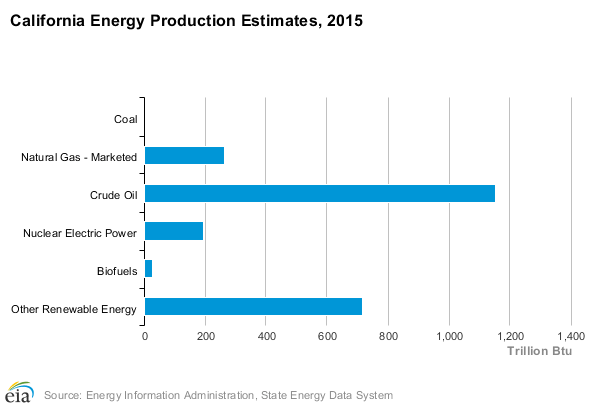
CA is the 3rd largest producer of oil behind Texas and North Dakota (https://www.eia.gov/state/?sid=CA) and is responsible for producing over 1100 Trillion BTUs of energy from crude oil alone. While it is not the sole consumer of this energy, it is effectively responsible for the GHG’s produced from the oil.
Within California, 44% of electric generation from natural gas. Clearly, CA hasn’t shed its reliance on fossil fuels. And let’s not forget its nuclear power plant at Diablo Canyon.
Unintended Consequences
California’s goal of obtaining 50% of energy from renewables by 2030 was signed into law in 2015. Yet, only 5.5% of it’s grid available energy is from solar, despite its claim,
“California leads the nation in solar thermal electricity capacity and generation. In 2016, California had 73% of the nation’s capacity and produced 71% of the nation’s utility-scale electricity generation from solar thermal resources.” (U.S. Energy Information Administration, California Profile Overview Facts, eia.gov, Nov 2017).
California is also the largest consumer of energy in the U.S., but ranks 49th in the nation on a per capita basis. This means California industries are consuming abundant amounts, while taking the incentives funded by taxpayer dollars, who are reducing their consumption.
Then, real problems exist for energy storage. Like the homes here, the idea of large battery banks across the state may not be feasible. Load displacement on a state scale would need to be buttressed by a regional grid agreement, which does not yet exist, although there are government advocates for it, including Governor Gerry Brown. This means that the energy generated from renewables must be consumed or distributed in real-time.
Except….
No plan exists for energy storage.
Additionally, State Bill 100 upgraded targets to 60% of energy from renewables by 2030 and then requires the final 40% to come from “zero-carbon” sources that don’t produce greenhouse gases by 2045. They expect the gap to be filled with large hydroelectric plants (which are currently not considered a renewable source under CA law). This also means the elimination of natural gas-powered generation plants, which currently fill the generation gap during peak consumption times. Oh, yeah, and they are closing their last nuclear power plant.
So, the California equation, as it is currently planned is:
0 natural gas generation + 0 storage capacity (battery or otherwise) = 0 ability to store and manage its power grid effectively during peak consumption times, times with no sun, and times of emergency.
What’s more, without a codified agreement within the western states, CA won’t be able to have planned, reliable redundancies. It is true that the state buys some hydroelectric power from the pacific north west, it is not capable of delivery that power to southern CA. That means large population centers like Las Angeles and San Diego will be isolated during a grid emergency.
Picture millions of people, in the hot desert conditions of SoCal without electricity, and without water (because pumping and sewage stations need power to work). Today, 28 million people live here. The modest drop in population projected won’t relieve the pressing need for a systemic energy plan for the region, and the state. https://la.curbed.com/2015/1/22/10000130/predicting-who-will-be-living-in-los-angeles-in-2030
So while we extol California for its hard work on behalf of the planet, the unintended consequences of is love of wind and solar is a neglect for the resilience of the same power grid.
 More Sustainable World
Hmmmm…. it seems behind every success story there lurks the nitty-gritty often unsavory details. You’ve woven a very convincing, yet not too optimistic picture (yet why in the back of my mind do I think Jerry Brown understands, or could understand all this if it were laid out for him, these issues??).
There are a lot of solid laid out facts here, that when added up create a compelling picture, but I feel a little bit short-changed simply because I’d like to know what are some viable solutions to all this? Are there prospective Plans A, or B, or C? If there are, are these on any meaningful agenda? What traction are they getting, if any? What is PG&E’s role in all this? Curiously, I am also wondering why Pacific Northwest power can’t connect down to San Diego and environs – doesn’t the north connect to the south and the north connect up towards Oregon and Washington (the tail bone’s connected to the hip bone, the hip bone’s connected to the……)??
I guess you’d expect all this coming from a Californian!!
Good job here!!
LikeLike
Thanks for your interest in this blog.
Like many issues, once interwoven with politics, it becomes burdened by special interests. The administration is aware of the shortcomings of existing policy and the jeopardy it puts on grid. This is why Gov. Brown was advocating a robust interconnection with the south western states. Similarly, the connections are not robust enough for total power from the northwest. Some issues are plain: line losses are significant over long distances. Some are a matter of how the grid is designed. I can say that I have seen the interconnect maps, and there are weaknesses. This is the same problem that most of the U.S. has, unfortunately. So, when you hear that our electrical infrastructure needs updating, it is, well and truly, an understatement. Consumer and more so, INDUSTRIAL, demand outpaced the planned design capacity decades ago. California’s greatest demand stems from industrial use. So, if we continue to demand “Made in the U.S.A.” we had better update our infrastructure systems to support it.
LikeLike